Worrying about low milk supply is one of the most common reasons moms stop breastfeeding earlier than they planned. Your baby fusses at the breast, wants to nurse around the clock, your breasts feel soft, the pump barely fills the bottle — and you start to wonder, "Is my baby getting enough?" Here's what every nursing mom deserves to hear first: most mothers make plenty of milk, and a true, lasting low supply is far less common than it feels.
This guide is your hub for everything about milk supply — how to tell whether yours is actually low, what causes it, how to increase it, when to get help, and how to stop the guesswork. Along the way, we'll link out to deeper articles on the specific questions moms ask most.
This article is for general information only and isn't a substitute for advice from your pediatrician or an IBCLC lactation consultant. If you're concerned about your baby's weight gain or feeding, contact your child's doctor.
What is low milk supply?
Low milk supply means your body is making less breast milk than your baby needs to grow and thrive. It's important to separate two very different situations:
\
-
Perceived low supply — by far the most common. Your milk is actually fine, but normal newborn behavior (frequent feeding, fussiness, soft breasts) makes it feel like you're running low.
-
True low supply — your baby genuinely isn't getting enough, shown by poor weight gain and too few wet diapers.
Most worry falls into the first category. The whole point of this guide is to help you tell the difference quickly and calmly — without unnecessary formula top-ups that can actually lower your supply.
How your milk supply really works?
Breast milk works on supply and demand. Every time your baby nurses (or you pump), your body gets the message: make more milk. The more often and more effectively milk is removed, the more you produce. The less often it's removed, the more your body dials back.
This is why the most powerful lever you have over your supply isn't a tea, a supplement, or a special diet — it's frequent, effective milk removal. Keep that one principle in mind and almost everything else in this guide will make sense.
Timeline: colostrum and your milk "coming in»
A lot of early supply panic is really just normal newborn timing. Here's what to expect in the first days: -
Days 1–2: Your body makes colostrum — a small amount of thick, golden "first milk" that's exactly what your newborn needs. Tiny volumes are normal; a newborn's stomach is only the size of a marble.
\ -
Days 3–5: Your mature milk "comes in," and you may feel fuller or engorged. If it's delayed past day 5 (more common after a C-section, a difficult birth, or with certain health conditions), reach out to a lactation consultant.
\ -
Weeks 1–6: Supply is driven by frequent removal as your body calibrates to your baby's needs.
\ -
After ~6 weeks: Supply regulates. Breasts often feel softer and you may leak less — this is your body becoming efficient, not a drop in supply.
Knowing this timeline helps you avoid unnecessary formula in the very first days, when supply is still being established.
How much milk does your baby actually need?
Breastfed babies take in less per feed than many parents expect — which is why a "small" pump session can feel alarming when it's actually normal. Rough guidance: -
First days: a few teaspoons of colostrum per feed.
-
By ~1 month to 6 months: roughly 24–30 oz (about 750–900 ml) per day, split across feeds, averaging around 3–4 oz (90–120 ml) per feed.
-
Breastfed babies' intake stays fairly steady from 1–6 months and doesn't keep climbing the way formula amounts sometimes do.
If your baby is gaining weight and making enough wet diapers, they're getting the milk they need — regardless of how much you can pump.
Is your baby getting enough? The two reliable signs
You can't measure supply by how full your breasts feel or how much you pump. There are really only two trustworthy indicators, and you can check both at home: -
Weight gain. After the first week or two, babies typically gain about 5–7 oz (150–200 g) per week in the early months. The American Academy of Pediatrics (AAP) and WHO both treat steady weight gain as the single best sign your baby is well-fed.
-
Wet and dirty diapers. From day 5–6 onward, expect at least 6 wet diapers in 24 hours with pale, clear urine, plus regular stools in the early weeks.
If both of these check out, your supply is very likely fine — even on the days it doesn't feel that way.
Signs of low milk supply
While weight gain and diapers are the headline indicators, several other cues can point to a problem when they appear together: a baby who's lethargic and hard to wake, who fusses with hunger right after a full feed, who doesn't swallow rhythmically while nursing, or who shows signs of dehydration like a dry mouth or sunken soft spot (fontanelle).
One cue on its own rarely means trouble. What should get your attention is the combination of poor weight gain plus fewer than 6 wet diapers a day.
For the full checklist and what each sign means, read our companion article: "Low Milk Supply: 7 Signs and What to Do.»
What's normal — and NOT a sign of low supply
So many moms wean over things that are completely normal. On their own, none of these mean your supply is low: -
Soft breasts that no longer feel full — totally normal once your supply regulates around 6–12 weeks.
-
Pumping only a small amount — a healthy baby is far more efficient than any pump; pump output is not a measure of supply.
-
Frequent nursing, especially in the evening — often cluster feeding, a normal pattern.
-
Fussiness during growth spurts or teething — temporary, not a supply problem.
-
Shorter feeds as your baby grows — an older baby simply nurses more efficiently.
-
No letdown tingle, or no leaking — many moms never feel letdown or stop leaking; neither reflects supply.
What causes low milk supply
When supply really is low, there's almost always a reason — and most are about how feeding is organized, not your body failing you. Clinicians divide causes into two groups.
Secondary causes (common and usually reversible)
These are the most frequent culprits, and the good news is you can do something about them: -
Infrequent feeds or long stretches between nursing — scheduling feeds or stretching to 3–4 hours reduces stimulation.
-
Skipping night feeds — prolactin, the milk-making hormone, peaks overnight, so night gaps drop supply fastest.
-
Early or unnecessary formula top-ups — every replaced feed signals your body to make less.
-
A shallow latch — baby nurses inefficiently and doesn't remove enough milk.
-
Overuse of pacifiers or nipple shields that cut into time and efficiency at the breast.
-
High stress, exhaustion, and pain — stress hormones interfere with letdown.
-
Certain medications and hormonal birth control (especially estrogen-containing) — worth reviewing with your doctor.
Primary causes (less common)
Sometimes supply is limited by underlying factors that need professional support: insufficient glandular tissue, retained placenta after birth, significant blood loss, thyroid or other hormonal conditions, PCOS, or prior breast surgery. These are less common — but if you've optimized everything else and supply is still low, they're worth investigating with your provider.
How to increase milk supply?
If you've confirmed your supply is genuinely low — or you simply want to protect it — here's what actually works, in order of impact.
1. Nurse more often, on demand
The single most effective step. Offer the breast at every hunger cue — 10–12 or more times in 24 hours, including overnight. Those early-morning feeds (roughly 3–8 a.m.) drive the most prolactin, so don't skip them.
2. Fix the latch
A shallow latch is the most common reason milk seems low: your baby nurses but doesn't remove much milk. Aim for a deep latch — a big mouthful of areola, not just the nipple, lips flanged outward, and audible swallows. If nursing hurts, the latch usually needs adjusting. (See our guide on getting a proper latch and comfortable positions.)
3. Use both breasts and breast compression
Offer both breasts at each feed. As your baby slows down, gently compress the breast with your hand to keep milk flowing and help them reach the richer, fattier hindmilk.
4. Add pumping — and try power pumping
Pump for 10–15 minutes, 2–3 times a day, after or between feeds. To give supply an extra push, try power pumping once a day: pump 20 minutes, rest 10, pump 10, rest 10, pump 10. This mimics cluster feeding and signals your body to ramp up. (See our guide on pumping and how to store breast milk safely.)
5. Prioritize skin-to-skin and rest
Skin-to-skin contact, a calm environment, and rest lower the stress hormones that block letdown. Hand off chores where you can and sleep when the baby sleeps — easier said than done, but it genuinely helps your supply.
6. Eat enough and stay hydrated
Drink to thirst (roughly 2 liters / 8+ cups a day) and eat regular, balanced meals — nursing burns extra calories. Lactation cookies, teas, and supplements (galactagogues) have weak evidence and won't replace frequent milk removal, though a warm drink before nursing can help your letdown.
If you need to supplement
Sometimes supplementing is medically necessary for a short time. The key is to do it without sabotaging your supply: -
Supplement only on your pediatrician's advice and based on objective signs (weight, diapers) — not "just in case."
-
Protect milk removal: for every bottle your baby takes, pump to tell your body to keep making milk.
-
Consider supply-protective methods like a supplemental nursing system (SNS) or paced bottle feeding so the baby keeps working at the breast.
-
Treat supplementing as a bridge, not a destination — many moms rebuild full supply with support.
Cluster feeding and growth spurts
Around 3 weeks, 6 weeks, 3 months, and other points, babies hit growth spurts and may nurse almost nonstop for a few days. This cluster feeding is not a sign of low supply — it's how your baby tells your body to make more. The worst thing you can do is panic-supplement; the best thing is to nurse on demand and ride it out. It usually settles within a few days. (More in our article on cluster feeding and growth spurts.)
Exclusive pumping and supply
If you're exclusively pumping, the same supply-and-demand rules apply: pump as often as a baby would nurse (8–10+ times a day in the early weeks), don't stretch overnight gaps too long at first, and make sure your flange fits correctly — a poor fit reduces output and can be mistaken for low supply.
When to call a professional
Don't wait to contact your pediatrician or an IBCLC lactation consultant if: -
your baby isn't gaining weight or is losing weight;
-
there are consistently fewer than 6 wet diapers a day;
-
your baby is lethargic, hard to wake, or refusing to feed;
-
you see signs of dehydration (dry mouth, sunken fontanelle);
-
nursing hurts and you can't fix it on your own;
-
you've optimized feeding and supply is still low (to rule out primary causes).
A lactation consultant can do a weighted feed, check for a tongue tie, fine-tune the latch, and build a plan tailored to you. Getting help early is one of the best things you can do to keep breastfeeding.
Take care of yourself, too
Supply worries take a real mental toll. Anxiety, pressure, and exhaustion not only feel awful — they can actually interfere with letdown. Be kind to yourself: fed is best when it has to be, breastfeeding isn't all-or-nothing, and even partial breastfeeding is valuable. If you're feeling persistently low, anxious, or overwhelmed, talk to your doctor — your wellbeing matters just as much as your baby’s.
Common myths about low milk supply
A few persistent myths push moms toward unnecessary supplementing. Let's clear them up: -
"Small breasts make less milk." False — breast size reflects fatty tissue, not milk-making capacity.
-
"If I can't feel a letdown, I have no milk." False — many moms never feel letdown yet have a full supply.
-
"My baby nurses all the time, so I must not have enough." Usually false — frequent nursing is normal newborn behavior and is exactly what builds supply.
-
"Pumping tells me how much milk I make." False — your baby is far more efficient than a pump.
-
"Once my supply drops, it's gone." False — supply can almost always be rebuilt with frequent, effective milk removal.
-
"I should drink a ton of water to make more milk." Drinking past thirst doesn't boost supply; just drink when thirsty.
Stop guessing: track your feeds with Momzy
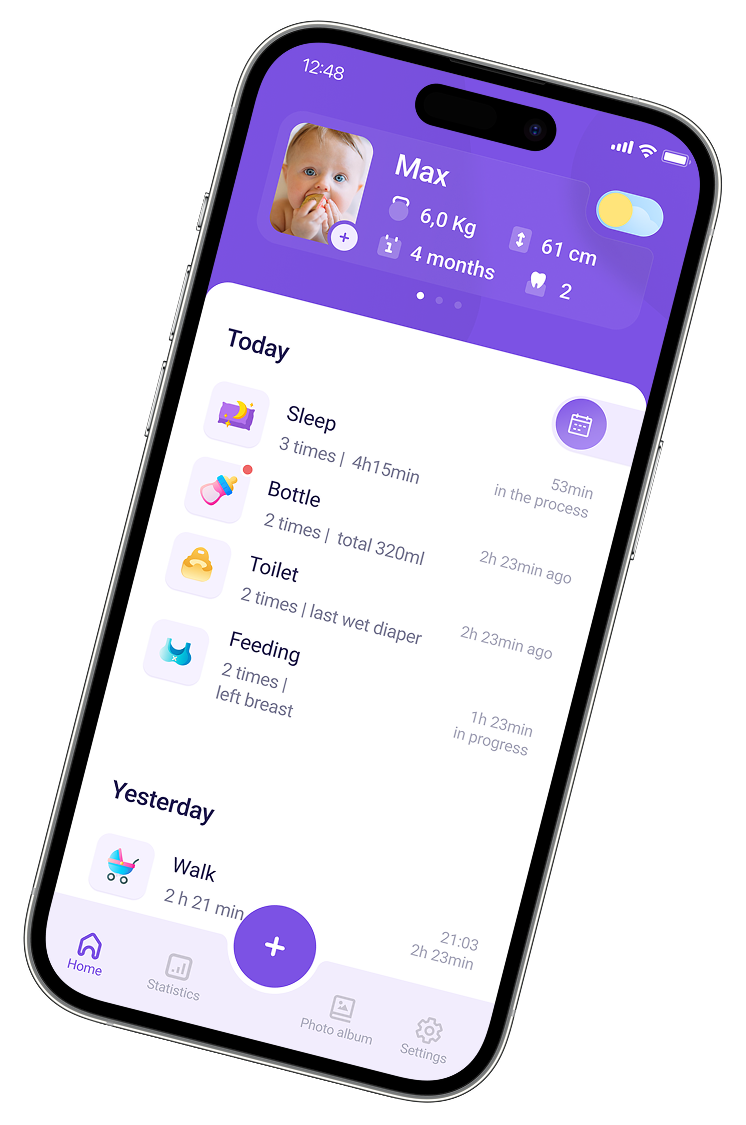
Most "low milk supply" anxiety comes down to one thing — not having the full picture. How often did your baby feed? For how long? How many wet diapers today? How is weight trending week over week? When the numbers are in front of you, the worry fades and a real problem shows up early, when it's easiest to fix.
The Momzy app makes this effortless: log every feed and its length, track diaper changes, and follow your baby's weight on a chart with WHO references — all in one place. In a day or two you'll know whether there's truly something to address or whether your baby is simply going through a growth spurt.
Download Momzy on the App Store, Google Play, or AppGallery and start your feeding log today. Peace of mind starts with clear numbers.
FAQ
1. How do I know if my milk supply is actually low?
Look at weight gain and wet diapers, not how your breasts feel or how much you pump. Steady weight gain and 6+ wet diapers a day mean your baby is getting enough.
2. Can I rebuild my milk supply after it drops?
Usually, yes. Frequent on-demand nursing, a deep latch, night feeds, and added (or power) pumping rebuild supply in most cases. A lactation consultant can speed things up.
3. Does pumping output show my real supply?
No. Babies remove milk far more efficiently than pumps. A low pump output is not proof of low supply.
4. Will one bottle of formula ruin breastfeeding?
No, but routine "just in case" top-ups reduce stimulation and can lower supply over time. Supplement only with your pediatrician's guidance, and pump to protect your supply.
5. How long does it take to increase milk supply?
Many moms see a difference within 3–7 days of more frequent, effective milk removal, though it varies.