Few milestones feel as exciting — or as confusing — as your baby's first bites of real food. Everyone has an opinion: your mom says four months, a friend swears by baby-led weaning at six, and the internet is full of conflicting charts. So when should you start solids, really? The short answer: around 6 months, when your baby shows clear signs of readiness — not on a fixed calendar date. This guide walks you through exactly when to start solids, the readiness signs that matter, what to skip, and how to make those first meals safe and stress-free.
This article is for general information only and isn't a substitute for advice from your pediatrician. Always talk to your child's doctor before starting solids, especially if your baby was born premature or has any health concerns.
When should you start solids? The short answer
Most babies are ready to start solids around 6 months of age. The American Academy of Pediatrics (AAP), the CDC, and the World Health Organization (WHO) all point to about 6 months as the sweet spot, with two firm guardrails:
-
Not before 4 months. A baby's digestive system and oral skills aren't ready earlier.
-
Not much later than 6 months. Waiting too long can make it harder to meet your baby's needs for iron and other nutrients.
But here's the key: 6 months is a guideline, not a magic switch. The real green light is your baby's developmental readiness, which we'll cover next. Some babies are ready a couple of weeks before 6 months; others need a little more time.
Why around 6 months?
By about half a year, several things line up at once. Your baby has usually doubled their birth weight, can sit upright with support, and has lost the reflex that pushes food out of their mouth. Just as importantly, their iron stores from birth start to run low around this age, and breast milk alone no longer fully covers their iron needs — so iron-rich solids become an important complement to milk.
Starting around 6 months also lands in a helpful developmental window for accepting new tastes and textures and for introducing common allergens, which we'll get to below.
Signs your baby is ready for solids
Age is just one clue. Before you offer that first spoonful, look for these signs your baby is ready for solids — ideally you'll see all of them together: -
Good head and neck control. Your baby can hold their head steady and upright.
-
Can sit up with support. They can sit in a high chair or propped up without slumping.
-
Lost the tongue-thrust reflex. They no longer automatically push food out of their mouth with their tongue.
-
Shows interest in food. They watch you eat, lean in, open their mouth, or reach for what's on your plate.
-
Can bring things to their mouth. Improving hand-eye coordination lets them move food (or a spoon) toward their mouth.
If your baby hits the 6-month mark but isn't showing these signs, it's fine to wait a week or two and try again. Readiness is about skills, not just the number on the calendar.
Signs that are NOT readiness cues
Plenty of normal baby behaviors get mistaken for "my baby needs food now." On their own, these are not reasons to start solids early: -
Waking more at night. Sleep regressions and growth spurts are normal and rarely fixed by solids.
-
Watching you eat. Curiosity is great, but interest alone isn't readiness — pair it with the physical signs above.
-
Chewing on hands or fussiness. Often teething or normal development, not hunger for solids.
-
Reaching a certain weight. A big baby isn't necessarily a developmentally ready baby.
Starting solids won't make your baby sleep through the night — that's one of the most persistent myths out there.
Why timing matters: too early vs. too late
Starting too early (before 4 months) can mean your baby isn't able to swallow safely, may displace nutrient-rich breast milk or formula, and puts extra strain on an immature digestive system. It's also been linked to a higher risk of choking.
Waiting too long (well past 6 months) has its own downsides: your baby may fall short on iron and zinc, may have a harder time accepting new textures, and you may miss the helpful early window for introducing allergens. Aiming for around 6 months — guided by readiness — keeps you in the safe middle.
Milk still comes first (for now)
In the beginning, solids are about practice and exploration, not replacing milk. Breast milk or formula remains your baby's main source of nutrition through the first year. A common saying captures it well: "food before one is just for fun" — meaning early solids complement milk rather than replace it.
Start with one small meal a day, offering just a teaspoon or two, and let your baby set the pace. Over the following weeks and months you'll gradually build toward two and then three meals a day as they eat more and rely a bit less on milk.
First foods: what to offer
There's no single mandatory "first food," but iron-rich foods are a smart priority since iron is the main nutrient babies need from solids. Good first options include: -
Iron-fortified infant cereal (mixed with breast milk or formula)
-
Pureed or well-mashed meat, poultry, or beans
-
Mashed or soft-cooked vegetables (sweet potato, carrot, peas)
-
Soft fruits (banana, avocado, cooked apple or pear)
Offer a variety of flavors and textures over time. There's no need to introduce foods in a strict order or to wait three days between every single food — though spacing out brand-new foods can help you spot any reactions.
Purees vs. baby-led weaning
You'll quickly run into two main approaches — and the good news is you can mix them: -
Spoon-fed purees: You offer smooth, then thicker, mashed foods on a spoon. Easy to control amounts and great for many families.
-
Baby-led weaning (BLW): You skip purees and offer soft, appropriately sized finger foods your baby feeds themselves from the start. It supports self-feeding and exposure to textures.
Neither is "better" — research shows both can work well. Many parents do a combination: some purees, some soft finger foods. Whichever you choose, make sure foods are soft enough to squish between your fingers and cut to a safe size.
Allergens: introduce early and often
This is where guidance has changed in recent years, so it's worth highlighting. Current AAP guidance is to introduce common allergenic foods early — around the time you start solids — rather than delaying them. Early, regular exposure may actually help reduce the risk of food allergies.
Common allergens to introduce include: -
Peanut (as smooth peanut butter thinned with water or mixed into food — never whole peanuts);
-
Egg (well-cooked);
-
Dairy (yogurt, cheese — but not cow's milk as a main drink before 12 months);
-
Wheat, soy, fish, shellfish, and tree nuts (in safe forms).
Introduce one new allergen at a time, ideally earlier in the day, so you can watch for any reaction. If your baby has severe eczema or a known food allergy, talk to your pediatrician first — they may recommend a specific plan.
Foods and drinks to avoid
Some foods aren't safe in the first year: -
Honey — risk of infant botulism before 12 months.
-
Choking hazards — whole nuts, whole grapes, popcorn, hard raw vegetables, chunks of meat or cheese, sticky globs of nut butter.
-
Cow's milk as a main drink before 12 months (small amounts in food are fine).
-
Added salt and sugar — babies don't need them, and their kidneys can't handle much salt.
-
Honey-sweetened or sugary drinks, juice, and anything with caffeine.
Always supervise meals, seat your baby upright, and never leave them alone with food.
How to start: a simple game plan
1. Pick a calm moment. Choose a time when your baby is alert and not overtired or starving — many parents start after a milk feed. 2. Seat them upright in a high chair with good support. 3. Offer a small amount — a teaspoon or two of a single food — once a day to begin. 4. Follow their lead. If they turn away, close their mouth, or lose interest, stop. Never force-feed. 5. Build up gradually. Add a second daily meal after a few weeks, then a third, expanding variety as you go. 6. Keep offering milk on demand — it's still their main nutrition this year.
Expect mess, funny faces, and rejected foods. It can take 10+ exposures before a baby accepts a new flavor, so keep offering without pressure.
How much should your baby eat?
In the early weeks of solids, portions are tiny — and that's exactly right. Your baby is learning to move food around their mouth and swallow, not hitting calorie targets. Here's a rough progression (always follow your baby's cues, not the clock): -
Around 6 months: Start with 1–2 teaspoons of a single food, once a day, and build up slowly. Most of their nutrition still comes from milk.
-
7–8 months: Work toward 2 meals a day, gradually increasing to a few tablespoons per meal, with more variety and textures.
-
9–11 months: Aim for 3 meals a day plus a small snack, including more finger foods and family-style options.
-
12 months: Three meals plus snacks become the main source of nutrition, with milk shifting to a supporting role.
There's no need to push a "clean plate." Let your baby decide how much to eat — your job is to offer healthy options on a reasonable rhythm, and theirs is to decide how much goes in.
What a typical day might look like (6–8 months)
Every baby is different, but a simple early-solids day often looks something like this: -
Morning: Milk feed on waking, then a small breakfast of iron-fortified cereal or mashed fruit an hour or so later.
-
Midday: Milk feed, with a lunch of pureed or soft-cooked vegetables and a protein (mashed beans, meat, or well-cooked egg).
-
Afternoon: Milk feed and, as your baby grows, a small snack like soft fruit pieces.
-
Evening: Milk feed before bed remains a comforting anchor to the day.
Notice that milk feeds still bookend everything — solids slot around them, not instead of them, in the first year. As your baby eats more over the coming months, the balance naturally tips toward food.
Gagging vs. choking: know the difference
New eaters gag a lot, and it can be scary — but gagging is normal and protective. A gagging baby is noisy, coughing, and moving food forward; they're handling it themselves. Choking, by contrast, is silent or high-pitched, with no effective cough and possible color change — and it needs immediate help. Learning the difference (and infant CPR/choking first aid) gives you confidence at the table.
When to talk to your pediatrician
Check in with your child's doctor if: -
your baby is approaching or past 6 months but shows no readiness signs;
-
they consistently refuse all solids over several weeks;
-
you see signs of a food allergy (hives, swelling, vomiting, trouble breathing — seek emergency care for severe reactions);
-
your baby was premature, or you're unsure about timing for any health reason;
-
you have questions about iron, growth, or your baby's weight gain.
Track those first meals with Momzy
Starting solids comes with a lot to keep track of: which foods you've introduced, which allergens and when, how your baby reacted, and how meals fit around milk feeds. Trying to remember it all — especially across grandparents and a nanny — is nearly impossible.
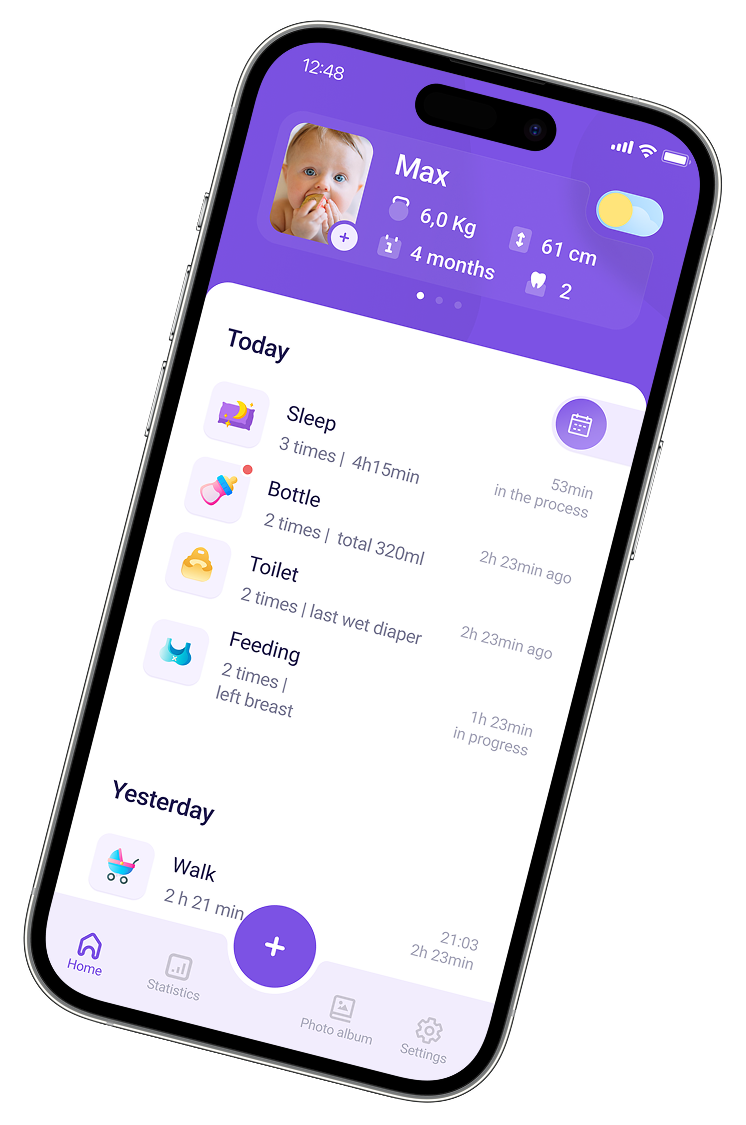
The Momzy app makes it simple: log each new food and allergen, note any reactions, track meals alongside feeds and sleep, and follow your baby's growth on charts with WHO references — all in one place. Invite your loved ones and nanny to the baby's profile so everyone stays in sync.
Download Momzy on the App Store, Google Play, or AppGallery and start logging your baby's solids journey today.
FAQ
1. When should I start my baby on solids?
Around 6 months, once your baby shows readiness signs — good head control, sitting with support, loss of the tongue-thrust reflex, and interest in food. Not before 4 months.
2. What are the signs my baby is ready for solids?
Steady head control, the ability to sit up with support, no longer pushing food out with the tongue, interest in your food, and bringing objects to their mouth.
3. Can starting solids help my baby sleep through the night?
No — that's a common myth. Night waking is usually about development and sleep cycles, not hunger for solids.
4. Should I do purees or baby-led weaning?
Both work, and you can combine them. Choose what fits your family, keep foods soft and safely sized, and always supervise.
5. Which foods should I avoid in the first year?
Honey, choking hazards (whole nuts, grapes, popcorn), cow's milk as a main drink, and added salt and sugar.