Watching your baby grow is one of the greatest joys of parenthood — and one of the biggest sources of "Is my baby on track?" worry. This complete guide to baby milestones by month walks you through what to expect from birth to 12 months across movement, language, social, and thinking skills, plus simple ways to support development and the signs that mean it's worth checking in with your pediatrician.
This article is for general information and is not a substitute for professional medical advice. Every baby develops at their own pace. If your baby was born prematurely, use their corrected age (age from the due date) when looking at milestones. Always discuss any concerns with your pediatrician.
\
What are developmental milestones?
Milestones are skills most babies reach by a certain age. They're usually grouped into four areas:
- Gross & fine motor — rolling, sitting, crawling, grasping, pointing.
- Language & communication — cooing, babbling, first words, understanding.
- Social & emotional — smiling, bonding, stranger awareness, waving.
- Cognitive — learning, problem-solving, exploring cause and effect.
Milestones are ranges, not deadlines. Reaching one a little earlier or later is usually completely normal — what matters most is steady progress over time.
\
Baby milestones by month (0–12)
Here's a month-by-month overview. Think of these as typical signs, not a checklist your baby must complete exactly on time.
\
| Age | Movement & motor | Language, social & cognitive |
|---|---|---|
| 1 month | Moves arms/legs, turns head, strong grasp reflex | Calms when held, focuses on faces ~8–12 in away, startles to loud sounds |
| 2 months | Holds head up briefly during tummy time, smoother movements | First social smiles, cooing sounds, follows objects with eyes |
| 3 months | Better head control, pushes up on forearms, opens/closes hands | Laughs, "talks" back with coos, recognizes familiar faces |
| 4 months | Rolls front to back, holds head steady, reaches for toys | Babbles, copies some sounds and expressions, enjoys play |
| 5 months | Rolls both ways, brings feet to mouth, grabs objects | Responds to own name forming, blows raspberries, curious |
| 6 months | Sits with support, begins to sit alone, passes objects hand to hand | Sits with support, begins to sit alone, passes objects hand to hand |
| 7 months | Sits without support, rocks on hands and knees | Looks for dropped toys, understands "no" tone, stranger awareness |
| 8 months | Begins crawling, pulls to stand, raking grasp | Babbles "mama/dada" (not specific), plays peekaboo |
| 9 months | Crawls well, stands holding furniture | Understands "no," points, copies sounds and gestures |
| 10 months | Pulls up and cruises along furniture, pincer grasp developing | Waves bye-bye, says "mama/dada" with meaning emerging |
| 11 months | Cruises confidently, may stand alone briefly | Follows simple requests, repeats sounds, imitates you |
| 12 months | May take first steps, refined pincer grasp, self-feeds finger foods | Says 1–2 words, understands simple instructions, plays interactive games |
A closer look by stage
0–3 months: getting to know the world
Newborns are busy learning to control their bodies and bond with you. Expect lots of sleeping and feeding, then around 6–8 weeks that first real social smile — a huge emotional milestone. Tummy time starts building the neck and shoulder strength they'll need for everything ahead.
\
4–6 months: reaching and rolling
Your baby becomes far more interactive — laughing, babbling, reaching for toys, and rolling over. By 6 months many babies begin to sit and are ready to start solids, opening a whole new world of textures and tastes.
\
7–9 months: on the move
Mobility takes off: sitting steadily, rocking, crawling, and pulling to stand. Socially, object permanence develops (they look for hidden toys), which is also why separation anxiety and stranger wariness often appear around now.
\
10–12 months: almost a toddler
Cruising along furniture leads toward those first independent steps. Communication blossoms — waving, pointing, imitating, and a first meaningful word or two. Your baby now understands far more than they can say.
\
How to support your baby's development
You don't need fancy toys — everyday interaction is what drives development:
- Tummy time daily from the early weeks to build strength.
- Talk, sing, and narrate your day — language exposure fuels speech.
- Read together every day, even with newborns.
- Respond to coos and babbles to build conversation skills.
- Offer safe floor time to move, reach, and explore.
- Play interactive games like peekaboo and pat-a-cake.
- Limit screen time (not recommended under ~18 months except video calls).
\
When to talk to your pediatrician ("act early»)
Trust your instincts and check in if your baby:
- isn't smiling socially by 3 months;
- doesn't hold their head steady or push up during tummy time by 4 months;
- isn't babbling or reacting to sounds by 6–7 months;
- isn't sitting with support by 9 months;
- doesn't respond to their name, point, or wave by 12 months;
- loses skills they once had (this always warrants a prompt call).
Early support makes a real difference, so it's always okay to ask. Remember to use corrected age for preemies.
\
How Momzy helps you track milestones
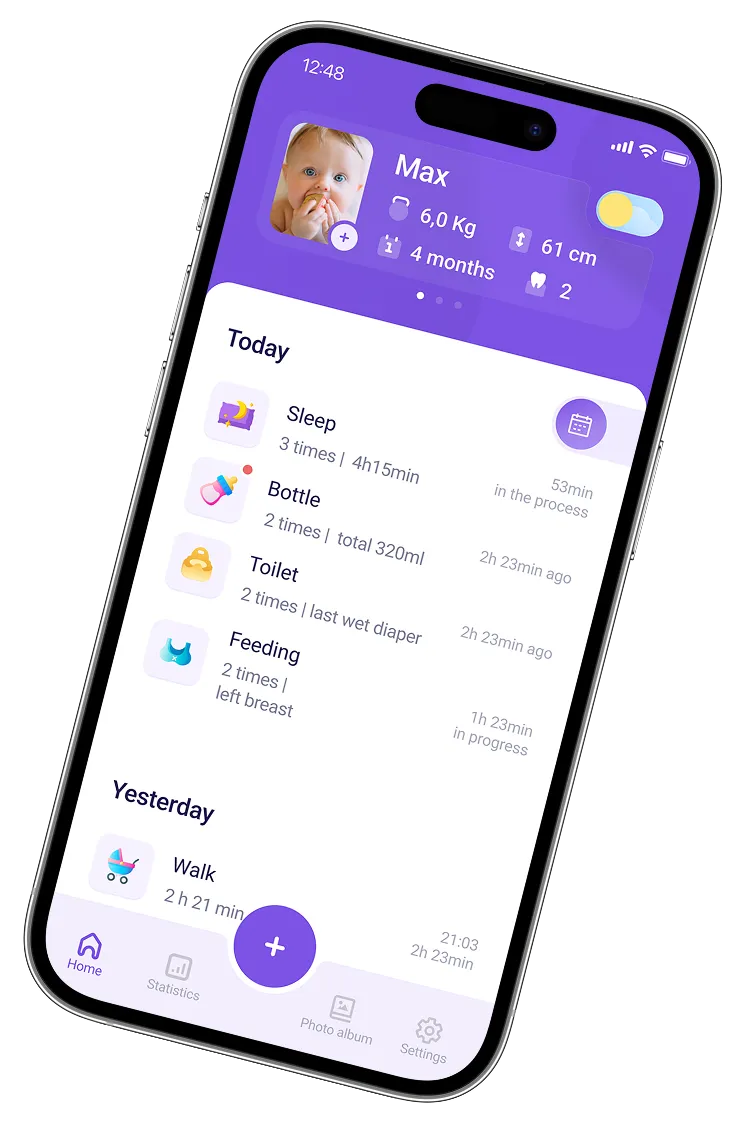
It's hard to remember exactly when your baby first rolled, sat, or said "mama." With Momzy, you can log developmental milestones as they happen, keep a timeline of those precious firsts, and track growth on WHO-based charts — all in one place you can share with your pediatrician at checkups. Shared family access means grandparents and your partner never miss a milestone, and gentle reminders help you know what to look for next.
Download Momzy free on the App Store, Google Play, or AppGallery and treasure every step of your baby's first year.
\
Key takeaways
\
- Milestones are ranges, not deadlines — steady progress matters more than exact timing.
- Development spans four areas: motor, language, social-emotional, and cognitive.
- Big first-year highlights: social smile (~2 mo), sitting (~6 mo), crawling (~8–9 mo), first steps and first words (~12 mo).
- Support development with tummy time, talking, reading, and play — not gadgets.
- Use corrected age for premature babies, and contact your pediatrician if your baby misses key milestones or loses skills.